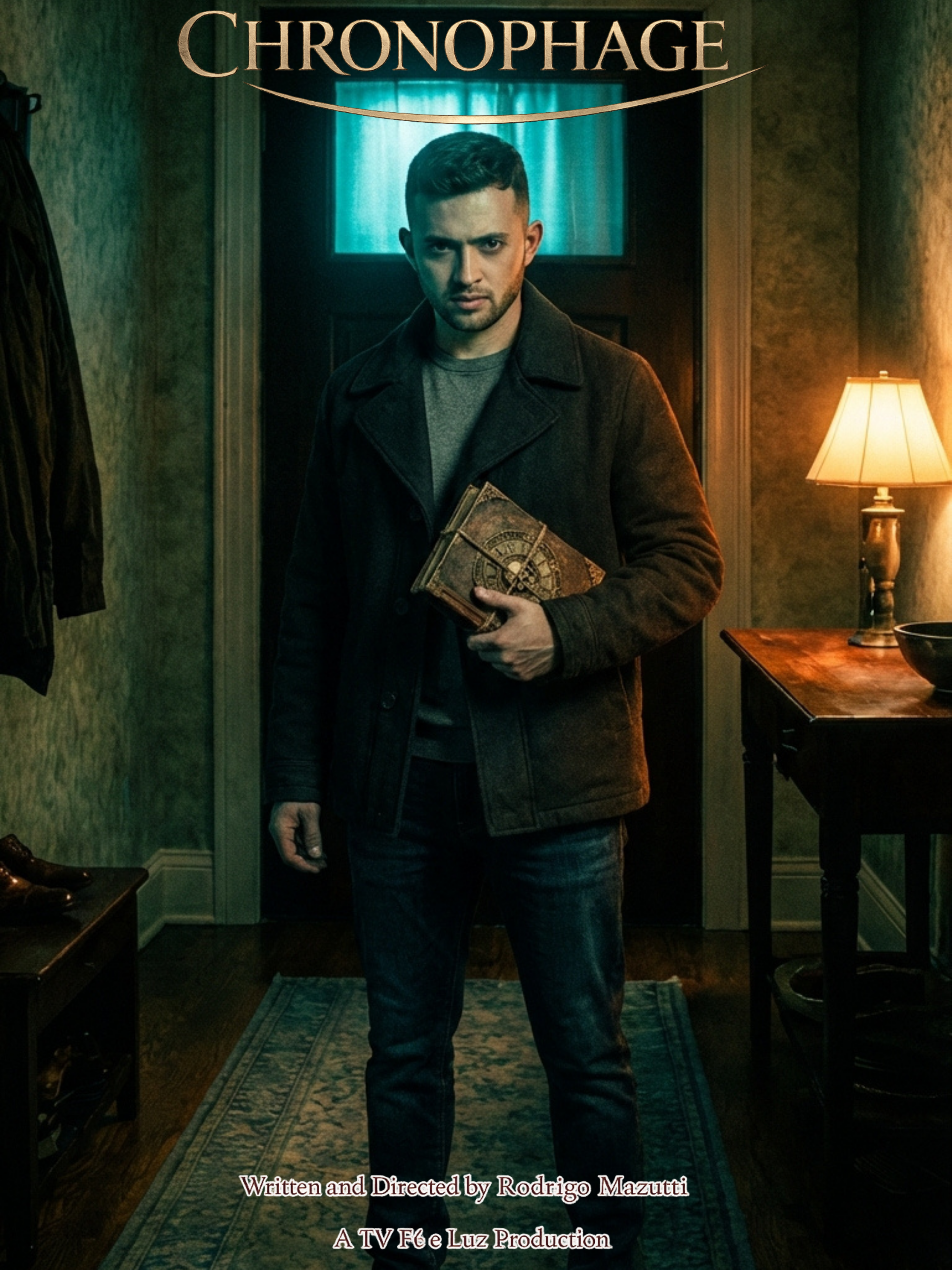
CHRONOPHAGE
O Cânone Oficial do Filme
Projeto cinematográfico do diretor Rodrigo Mazutti
Exibição e distribuição: TV Fé e Luz – Portal R29
I. O Mundo
A história de Chronophage se passa no nosso mundo — não em uma realidade paralela — mas em um mundo onde certas verdades existem sob a superfície do visível.
O tempo não é linear como os humanos o percebem. Ele é estratificado, sedimentar, como camadas geológicas. A consciência humana atravessa essas camadas de forma sequencial, mas a existência em si não obedece a essa limitação.
Alguns seres sabem disso.
Nas tradições fragmentadas de vilas costeiras da Nova Inglaterra, eles são chamados de Neiridianos.
II. Os Neiridianos
Os Neiridianos não são deuses.
Não interferem.
Não alteram eventos.
Não concedem milagres.
Eles observam.
Existem fora da experiência humana de tempo. Para eles, nascimento e morte coexistem. Perda e restauração são estados adjacentes.
O termo humano “Chronophage” — devorador de tempo — é um erro de interpretação.
Eles não consomem o tempo.
Eles o suportam em sua totalidade.
São guardiões da continuidade.
III. A Estátua (O Chronophage)
A estátua submersa não é o ser.
É um marcador.
Um ponto de ancoragem colocado séculos atrás em espaços liminares — onde a terra encontra o mar. Lugares de transição. De fronteira. De passagem.
A estátua não fala.
A estátua não se move.
O que Clay ouve não é som.
É proximidade.
Quando uma consciência humana se alinha profundamente com luto, tempo e rendição, a fronteira entre percepção e memória se torna tênue.
A voz é interna — mas não imaginada.
É o eco do tempo observado de fora.
IV. Clay
Clay vive sozinho na costa da Nova Inglaterra.
Anos antes dos acontecimentos do filme, seus pais morreram em um acidente de barco. A tragédia foi abrupta, brutal e definitiva. Não houve despedidas prolongadas. Apenas o silêncio posterior.
A perda interrompeu algo essencial dentro dele.
Ele não vive isolado por escolha. Ele vive suspenso.
Clay não é suicida.
Ele não busca morrer.
Ele busca silêncio.
Ele está preso na repetição mental de “como poderia ter sido”. Para ele, o tempo parece roubo — um fluxo que leva embora o que não pode ser recuperado.
Sua vida externa continua.
Mas internamente, ele permanece ancorado no passado.
V. O Grimório
O grimório não é mágico no sentido tradicional.
Não é um livro de feitiços.
Não concede poder.
Ele surge quando uma consciência atinge um limiar — quando alguém está pronto para confrontar o tempo, em vez de resisti-lo.
O livro contém fragmentos, pois a verdade não pode ser entregue inteira.
Ele não dá ordens.
Ele convida à contemplação.
Canonicamente, o grimório é um artefato Neiridiano. Não foi escrito com tinta. Ele se manifesta pela percepção. Surge fisicamente, mas é gerado metafisicamente.
Não aparece para todos.
Somente para aqueles que estão prontos para soltar.
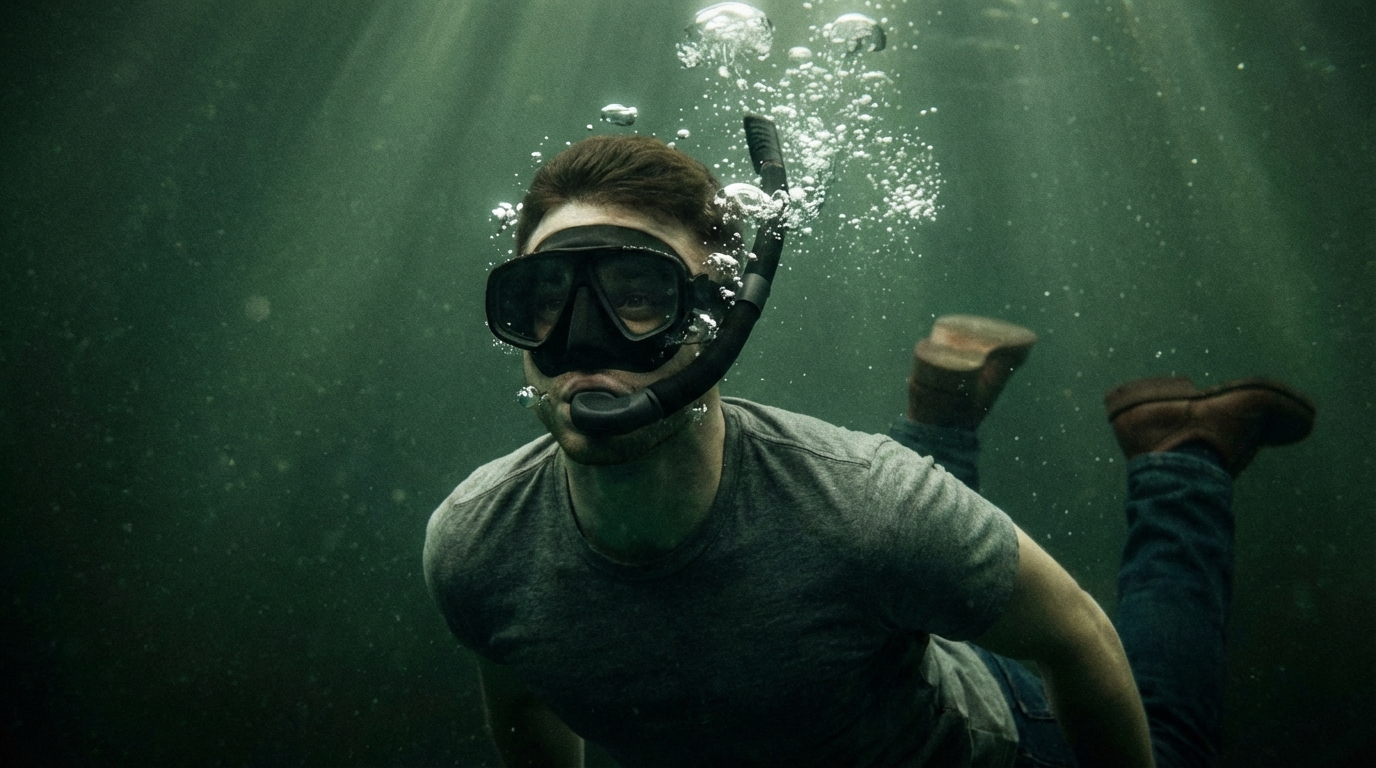
VI. A Descida
Quando Clay entra na água, não é um ato de imprudência.
É imersão simbólica.
A água representa memória — fluida, reflexiva, distorcida.
A descida é interna.
O filme evita mostrar luta porque a história não é sobre sobrevivência física.
É sobre confronto.
Clay não se afoga.
Não desmaia.
Não alucina.
Ele escuta.
VII. A Voz
A voz não pertence a um único Neiridiano.
É a perspectiva do tempo sem arrependimento.
Quando diz que o tempo não concede segundas chances, mas primeiras chances disfarçadas de dias comuns, afirma o seguinte:
Os humanos esperam correções dramáticas.
Mas a transformação se esconde na repetição imperceptível.
A tragédia do tempo não é que ele passa.
É que raramente percebemos quando algo começa.
VIII. O Barquinho
O pequeno barco de madeira é central na narrativa.
Quando criança, Clay construiu um barquinho com o pai, numa tarde aparentemente comum. Nada extraordinário aconteceu naquele dia.
Mas aquele foi um dos “primeiros momentos” disfarçados de ordinário.
Após a morte dos pais no acidente marítimo, o mar passou a representar ausência.
O barquinho que retorna à margem simboliza a memória que insiste em reaparecer.
Quando Clay o solta novamente na água, ele não abandona o passado.
Ele o reconhece.
Não tenta revivê-lo.
Não tenta corrigi-lo.
Ele aceita continuidade.
IX. O Final
Nada sobrenatural é confirmado.
Nada é negado.
Clay não ganha poderes.
Não recebe respostas absolutas.
Não resolve o tempo.
Ele altera sua relação com ele.
Os Neiridianos continuam observando.
O tempo continua estratificado.
A vida continua.
Mas Clay já não resiste à persistência do tempo.
X. Núcleo Temático
Chronophage é sobre:
-
Luto sem espetáculo
-
Tempo como resistência, não inimigo
-
Memória como maré
-
Aceitação sem explicação
-
A sacralidade dos dias imperceptíveis
O filme é deliberadamente ambíguo em sua forma.
Mas canonicamente, não é aleatório.
CHRONOPHAGE
The Official Canon of the Film
A cinematic project by director Rodrigo Mazutti
Exhibition and distribution: TV Fé e Luz – Portal R29
I. The World
The story of Chronophage takes place in our world — not in a parallel reality — but in a world where certain truths exist beneath the surface of what is visible.
Time is not linear as humans perceive it. It is stratified, sedimentary, like geological layers. Human consciousness passes through these layers sequentially, but existence itself does not obey this limitation.
Some beings know this.
In the fragmented traditions of coastal villages in New England, they are called Neiridians.
II. The Neiridians
The Neiridians are not gods.
They do not interfere.
They do not alter events.
They do not grant miracles.
They observe.
They exist outside the human experience of time. For them, birth and death coexist. Loss and restoration are adjacent states.
The human term “Chronophage” — devourer of time — is a misinterpretation.
They do not consume time.
They endure it in its entirety.
They are guardians of continuity.
III. The Statue (The Chronophage)
The submerged statue is not the being.
It is a marker.
An anchoring point placed centuries ago in liminal spaces — where land meets the sea. Places of transition. Of borders. Of passage.
The statue does not speak.
The statue does not move.
What Clay hears is not sound.
It is proximity.
When a human consciousness aligns deeply with grief, time, and surrender, the boundary between perception and memory becomes thin.
The voice is internal — but not imagined.
It is the echo of time observed from the outside.
IV. Clay
Clay lives alone on the coast of New England.
Years before the events of the film, his parents died in a boating accident. The tragedy was abrupt, brutal, and definitive. There were no long goodbyes. Only the silence that followed.
The loss interrupted something essential within him.
He does not live in isolation by choice. He lives suspended.
Clay is not suicidal.
He is not seeking death.
He is seeking silence.
He is trapped in the mental repetition of how it could have been. For him, time feels like theft — a current that carries away what cannot be recovered.
His external life continues.
But internally, he remains anchored in the past.
V. The Grimoire
The grimoire is not magical in the traditional sense.
It is not a spellbook.
It does not grant power.
It appears when a consciousness reaches a threshold — when someone is ready to confront time rather than resist it.
The book contains fragments, because truth cannot be delivered whole.
It does not give orders.
It invites contemplation.
Canonically, the grimoire is a Neiridian artifact. It was not written with ink. It manifests through perception. It appears physically, but it is generated metaphysically.
It does not appear to everyone.
Only to those who are ready to let go.
VI. The Descent
When Clay enters the water, it is not an act of recklessness.
It is symbolic immersion.
Water represents memory — fluid, reflective, distorted.
The descent is internal.
The film avoids showing struggle because the story is not about physical survival.
It is about confrontation.
Clay does not drown.
He does not faint.
He does not hallucinate.
He listens.
VII. The Voice
The voice does not belong to a single Neiridian.
It is the perspective of time without regret.
When it says that time does not grant second chances, but first chances disguised as ordinary days, it is stating the following:
Humans expect dramatic corrections.
But transformation hides within imperceptible repetition.
The tragedy of time is not that it passes.
It is that we rarely recognize when something begins.
VIII. The Little Boat
The small wooden boat is central to the narrative.
As a child, Clay built a small boat with his father on what seemed to be an ordinary afternoon. Nothing extraordinary happened that day.
But that was one of those “first moments” disguised as ordinary.
After his parents died in the maritime accident, the sea came to represent absence.
The little boat returning to the shore symbolizes memory that insists on resurfacing.
When Clay releases it into the water again, he is not abandoning the past.
He is acknowledging it.
He does not try to relive it.
He does not try to correct it.
He accepts continuity.
IX. The Ending
Nothing supernatural is confirmed.
Nothing is denied.
Clay does not gain powers.
He does not receive absolute answers.
He does not solve time.
He changes his relationship with it.
The Neiridians continue observing.
Time remains stratified.
Life continues.
But Clay no longer resists the persistence of time.
X. Thematic Core
Chronophage is about:
-
Grief without spectacle
-
Time as endurance, not an enemy
-
Memory as tide
-
Acceptance without explanation
-
The sacredness of imperceptible days
The film is deliberately ambiguous in its form.
But canonically, it is not random.